A QUESTION OF BALANCE: by brian zelley
BALANCE is the first word in effective punching skills, and
balance is necessary for effective footwork and movement.
So why do so many amateur boxers have poor
footwork, movement and balance?
Some of the issues:
.Moving out of range,
.rushing forward, and
.not co-ordinating the movement of the feet
with the movement of the punches.
Moving Out Of Range
.there is nothing wrong with moving out of range
of the target from time-to-time, but excessive
movement and distance away from an opponent
minimizes the effectiveness and the ability
to score counter-punches or take advantage of
an opponents error in stance, style or execution
of punches. Also, it is a waste of valuable energy.
Rushing Forward
Often we see boxers rush towards the opponent without
thinking about the risks of rushing into a left hook or
a right cross. And, that could spell real trouble if you
catch a heavy shot while moving into it.
One of the best for moving forward after an opponent was
the great JOE LOUIS. But, Joe did not rush towards his
opponents, instead he stalked them like a cat, measured
the distance and then unloaded the fire power with very
effective results.
At the beginning of each round, both boxers will be or should be
moving towards each other. The key risk factor, for boxers at the
beginning of a round is for the opponent to move quickly within
striking distance and fire a power left hook or right cross. Sometimes,
this strategy by the offensive boxer will be very effective and if the blow
lands, it could be a game changer. So, the important lesson is to be aware
of the opening blitz by a potential opponent at the beginning of a round.
Sometimes this strategy may be used in the final round by a boxer that
appears to be on the losing end of the judges' scorecards after two rounds.
That type of strategy is the one of desperation, but for the opponent that
thinks he has it in the bag can sometimes have a rude awakening as to
the importance of being a bit cautious at the start of any round.
Tuesday, May 10, 2011

Monday, February 7, 2011
BOXING SKILLS Body Punching
BOXING SKILLS - BODY PUNCHING: By Brian Zelley
The art of body punching for many is a lost art due in part to
the scoring system used in International Amateur Boxing.
Flashback 30 years to 1981 and the story was the same.
The RING magazine Associate Editor, Randy Gordon outlined
the issue in the December 1981 issue. The article was titled
randy gordon on The Once Glorious Art Of Body-Punching
Takes A Licking.

The story started with a look back at one of the Ali vs Frazier fights.
Ali was quoted:
"The fight was the closest thing to death. Frazier hit me with
body punches that made we want to quit.
JOE FRAZIER was also quoted:
"Kill the body and the head will die"
In his article Gordon mentions some great body punchers such as
Henry Armstrong, Tony Zale and Robert Duran.
Getting back to amateurs in top level competition,
the body punching skills and application appears to be
a non-starter. So the question is when are the high level officials
and coaches in amateur boxing going to recognize the importance
and traditions of the sport of boxing after all competition in the ring
is not a fencing duel with boxing gloves.
The art of body punching for many is a lost art due in part to
the scoring system used in International Amateur Boxing.
Flashback 30 years to 1981 and the story was the same.
The RING magazine Associate Editor, Randy Gordon outlined
the issue in the December 1981 issue. The article was titled
randy gordon on The Once Glorious Art Of Body-Punching
Takes A Licking.

The story started with a look back at one of the Ali vs Frazier fights.
Ali was quoted:
"The fight was the closest thing to death. Frazier hit me with
body punches that made we want to quit.
JOE FRAZIER was also quoted:
"Kill the body and the head will die"
In his article Gordon mentions some great body punchers such as
Henry Armstrong, Tony Zale and Robert Duran.
Getting back to amateurs in top level competition,
the body punching skills and application appears to be
a non-starter. So the question is when are the high level officials
and coaches in amateur boxing going to recognize the importance
and traditions of the sport of boxing after all competition in the ring
is not a fencing duel with boxing gloves.
Sunday, December 12, 2010
TRAGIC BOXING STORIES
TRAGEDY IN THE RING and BEYOND by brian zelley
Two years that standout as very tragic years are 1980 and 2009.
The loss of the 1980 USA Olymoic team in 1980 is likey the most significnt tragedy.
Two years that standout as very tragic years are 1980 and 2009.
The loss of the 1980 USA Olymoic team in 1980 is likey the most significnt tragedy.
Wednesday, April 28, 2010
COOL, CALM & CONTROL

Photo: 1970 - JACK MEDA and DARRYL OLSEN - Canadian Champions -
COOL, CALM & CONTROL in BOXING; By Brian Zelley - -
As we analyze, watch and view thousands of boxing bouts is it obvious
which boxer is controlling the bout?
Often for the novice amateur there is no real control of a bout but
a series of punches in the general direction of the other guy.
One theory is if you throw enough punches or more than the other dude,
then you own the bout. Then there are those cases when a boxer unloads
very few blows, but in the last 30 seconds throws a barrage of punches
in hopes of winning the round. Long-term victory an advancement
to an elite position in amateur boxing can't be guaranteed with those
two examples. However, both approaches can be used from time-to-time
as a strategic move, but not as an overall strategy.
COOL and CALM in the Heat of the battle:
Staying cool & calm before the opening bell is easier said than done,
because for all boxers before the opening bell there is that nervous
anticipation. Depending on the degree of nervous anticipation, the
emotional feeling can be a positive force or the beginning of
a bad night at the fights. The critical point is just before
the opening bell when each boxer needs to be the coolest and calmest
dude in the arena or hall. However, there is an optimum point of
calm, at one point being over cool or calm can lead to
losing the edge that often comes with the nervous emotion.
Two textbook cases of cool and calm in BC boxing history was a Sixties
Golden Gloves tournament with Seattle boxer WESLEY CRAVEN and a case
of a Victoria club show bout that had the return of former Prince George
boxer HAROLD HANDLIN back to the ring to face Langley boxer DEREK AUSTIN.
In one of the bouts, Craven faced heavyweight boxer JACK MEDA who would go on
to earn a medal in Interntional competition , beome a Canadian champion and earn a spot
in the Prince George Sports Hall of Fame. But, the night he faced Wes "Mr. Cool" Craven
it was a different story. Craven was whistling before he got into the ring, and after the opening bell
it took a few slick moves and a short right hand and the deed was done.
Then there was Harold {The Great" Handlin being the coolest dude in
Victoria despite not having a fight for over a year, but it didn't
take long after the opening bell to have Derek "the pride an joy of
Langley" Austin down for the count after a slick few moves by Harold.
Before the bout,Harold was so cool that he was smoking a cigarette when
he had his gloves on waiting to climb the ringside steps. Of course
someone else was holding the smoke, (CAUTION - smoking is bad
for your health, but that one night in a Victoria club show, it was
the other guy who felt the ill effects of the smoking boxer
better know to some as the "Blond Bomber").
Bad Decision or Not Getting Paid:
* Emotions sometimes take control, but then the risk
factor for bad things can then happen.
* Whatever the issue, the boxer and his cornermen/trainers
need to control the emotion in the heat of the moment, and try
to keep "Cool" and "Calm". Easier said than done, but the
alternative may lead to higher levels of emotional or physical
hurt and pain.
If bad things do happen and the boxer is punished, then try the
cool and calm before stepping into that little room to meet the
judges of your fate re. any appeal decision.
Tuesday, April 27, 2010
Where Are The Warriors & the Skills


2010 BC GOLDEN GLOVES = lessons to learn: By Brian W Zelley -
It has been a long time since BC had an amateur boxer in the Olympics, that was 2000 with Donnie Orr.
In previous years there would be a parade of activity leading up to any Olympic year with the best of the best
competing with the best in numerous tournaments and club shows. Out of a parade of open class boxers there was always a chance that at least one would make it into Olympic competition.
For 2010, many of the open class boxers took a raincheck on the Golden Gloves for a variety of reasons,
so it is difficult to measure their potential for future international competition.
Depending on their goals and timelines, for each open class boxer and even the novice boxers,
there comes a time when taking a pass on an important Provincial tournament will spell
a closed door for potential selection for Boxing Canada team selection.
For many of the open class boxers, the road will end without the opportunity to compete in
major International competition, so the real hope for Boxing BC lies in the junior open boxers and the now novice boxers.
But, there can be no promises of a free ride to the Commonwealth Games, Pan Am Games or the Olympics in 2016.
For the young novice boxers there is hope, but the road to open class success is paved with toil
and a few setbacks along the way. but dedication to learn the required skills and the willingness to engage
in a variety of open class tournaments against the best is a good blueprint to follow - a boxing blueprint -
building today's boxers for tomorrow's journey - dedication, availability, co-operation. communication,
activity, and the best of effective skills
One of the important detours that they must make is a return to square one to learn the basic skills from the ground up.
Wednesday, April 21, 2010
BOXING SKILLS 101 -


ELITE BOXING SKILLS: By Brian W. Zelley, B. Com, CA
The road to an Olympic medal is paved with years of training to fine tune the skills that must be present.
Many boxers in the past have travelled the road of acquiring a broad range of ring skills,
travelled the road to compete against quality opponents and still fall short
of being selected for a National team to compete in a major International tournament
for a variety of reasons that go beyond skill and ability such as injury or a brief fall from
dedicated training or sometimes the luck or bad luck of a draw or an elinination tournament
like the Canadian Senior/Elte National Box-Off "dance" that is played out. Sometimes for the
non-super heavyweights
it could be a sudden change in weight that eliminates a candidate from viable competition.
Some of the team members may not have perfection in all of the skills, but often this is made-up with
dedication and determination and the ability to fight through and over the many barriers.
THE IDEAL BOXER for OLYMPIC SUCCESS
.Demonstration of all the required boxing skills - adequate stance, adequate footwork and movement,
the proper use of all the punches and the ability to throw them in a variety of combinations, wide range of defensive skills,
and if possible the efficient and effective use of special techniques such as feinting, the ability to go at a rapid pace for three rounds, and the ability to fight effectively against a wide range of skilled boxers, and the ability to change strategy during a bout or a combination.
WHEN TO START
The time to start working on the elite boxing skills is day one. Often, due to limited coaching staff,
or coaches that may not have mastered the ability to demonstrate all boxing skills, or other reasons,
boxers are being rushed into using skills before the basic requirements are mastered.
AN EXAMPLE:
In 1985, although I was no longer an official coach and serving as an official in British Columbia, I still
visited a local club where I had been coaching. Boxers were preparing for a Diamond Belt Tournament
and I agreed to work with one boxer that did not have all of the ring skills necessary. After two weeks, the boxer
had fine tuned his footwork and movement, eliminated all of the awkward punches and was ready to fight
with just the basics - straight punches with emphasis of the jab, blocking skills without resorting to
ineffective footwork and avoiding the use of hooks and uppercuts. He stuck to basics and won his fight
and was singled out for the news story in the local newspaper with the headlines
- " xxxxxx In Ring Shocker At Diamond Belt Meet"
"Victoria boxer xxxx pulled off a big surprise Saturday night when he defeated Vancouver's yyyyyyyy..."
",,,,,yyyyy couldn't come up with the punching power nor the speed to overcome
the developing skills of xxxxx" - Times=Colonist, Monday January 21, 1985.
Tuesday, April 20, 2010
BC Golden Gloves - The Learning Experience - Participation & Co-operation
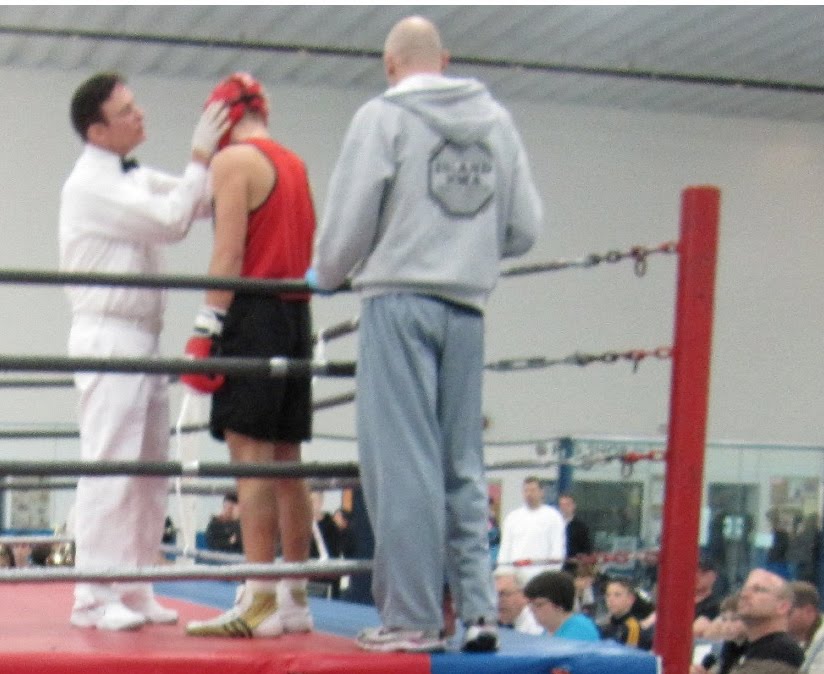


2010 BC GOLDEN GLOVES - Beyond the final bell: By Brian W. Zelley
(photo Bob Pegues and Brian Zelley)
Now that the 2010 BC Golden Gloves that took place at the Eagle Ridge Community Centre
in Langford (Greater Victoria) is history, for the wise, they become a learning experience and a teaching opportunity for
the boxers, coaches and officials.
The relatively new CAPITAL CITY BOXING CLUB proved that they could host the tournament in Greater Victoria.
Part of the success was the importance of volunteers that started with smiling faces greeting you at the door.
Of course, the long-term need for amateur boxing is the need for all Island Clubs to co-operate in getting the job done.
Special thanks to CHRIS JONES that had his plate full from the moment the club agreed to host the tournament.
The NANAIMO BOXING CLUB demonstrated the spirit of Co-operation by providing the ring which required a 70 plus mile ride
from Nanaimo to Langford, and extra time to take down the ring at the end of the tournament and then return to Nanaimo.
Special thanks to BARRY CRESWELL who was still working on the ring set-up one-hour before the starting time
For any club show or tournament to take place there is a need for participation. That positive quality
was demonstrated by the 2 Rivers or as documented in the program Two Rivers Boxing Club of Quesnel, BC.
Coach WALLY DOERN and nine Quesnel boxers participated to take another snall step in their combined
boxing journey but a giant leap in the PARTICIPATION area.
But, beyond the final bell, each person has a learning opportunity from this 2010 Experience.
Each boxer and coach will be able to review the results and draft a plan to fine tune the strengths and minimize the weaknesses.
Subscribe to:
Posts (Atom)

